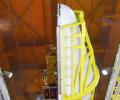
PSLV-C51/Amazonia-1 is the first dedicated commercial mission of NewSpace India Limited, Indian Space Research Organisation's commercial arm.

The ISRO chief further said that the ISRO is ready to fulfill the vision put forth by Prime Minister Narendra Modi.

For the second time, the Department of Space has declined to give details on why punitive action was taken against former chief Indian Space Research Organisation G Madhavan Nair in connection with the controversial Antrix-Devas deal, evoking a sharp reaction from the scientist who said there is "something fishy".

Following the postponement of the Axiom 4 mission, Group Captain Shubhanshu Shukla's father, Shambhu Dayal Shukla, said that his family is 'mentally' prepared for the mission.

'This may open up doors for private players in India to collaborate with global players in commercial missions.'
The Indian Space Research Organisation's Satish Dhawan Space Centre in Sriharikota will soon initiate the process of creating Third Launch Pad for human transportation into space, SHRC Director Chandra Datttan on Tuesday said during Republic Day celebrations.

Dr Rao accelerated the development of rocket technology which led to the successful launch of ASLV and PSLV satellites.

The tableau also showcased the participation of women scientists in various missions of the Indian Space Research Organisation (ISRO), which is now planning to carry out India's maiden human space flight next year.
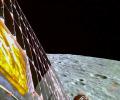
According to the Indian Situational Space Awareness Report for 2023, the nominal lift-off of the Launch Vehicle Mark-3, carrying the Chandrayaan-3 spacecraft, had to be delayed by four seconds based on the Collision on Launch Avoidance analysis.

'With India's growing capabilities in the space sector, this creates promising opportunities for enhanced collaboration and market access.'

Modi addressed scientists at the Indian Space Research Organisation command centre in Bengaluru, who were involved in the Chandrayaan-3 mission and lauded them for their efforts.

'In investing, poor sentiment is always a good vintage to build a portfolio.'
The successful landing of the Moon Impact Probe on the lunar surface has not only boosted the confidence of ISRO to undertake inter-planetary travel in future, but also conveyed a firm message to the world that India means business in the field of space, ISRO chief G Madhavan Nair said in Bengaluru on Friday.

On Sunday, July 30, 2023, the Indian Space Research Organisation successfully launched its proven Polar Satellite Launch Vehicle rocket carrying seven Singapore satellites from the Satish Dhawan Space Centre in Sriharikota and placed them into intended orbits.

On Thursday, NASA announced that it was working with Roscosmos to understand a new pressure signature, after the recent post-repair effort in the aft-most segment of the International Space Station's Zvezda service module.
ISRO Chairman G Madhavan Nair acknowledged that with the booming IT sector absorbing young engineers with fat pay packets, other fields are facing the brunt.
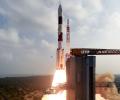
The launch is scheduled at 11.46 am on November 26, said the national space agency headquartered in Bengaluru.
Highlighting the achievements of ISRO, he said the organization, which had modest beginnings several decades ago, is trying to establish itself as the leading player in the area of satellite launches.
The T-52 hour countdown for the launch of the PSLV-C7 began at 0548 hours on Monday, and it was progessing smoothly.
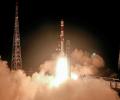
The Indian government has approved the construction of a third launch pad at Sriharikota, capable of sending heavier spacecraft into orbit. This new facility will support India's ambitious space program, including the Gaganyaan human spaceflight mission and a lunar landing. The launch pad will be built at the Satish Dhawan Space Centre and is expected to be operational within four years.
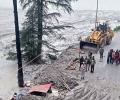
Experts question whether a cloudburst caused the recent flash flood in Uttarkashi, India, citing insufficient rainfall and other potential factors like ice chunks, rockfalls, or landslides.

Even if there is an early agreement on a cessation of hostilities in West Asia, the price shock will not go away easily, points out A K Bhattacharya.
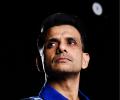
Indian astronaut Shubhanshu Shukla will be the first Indian to travel to the International Space Station (ISS), flying aboard a SpaceX Dragon spacecraft as part of a joint effort between NASA and ISRO. Shukla, a group captain in the Indian Air Force, will serve as the pilot for the Axiom Mission 4, scheduled for launch no earlier than spring 2025. The mission will also carry the first astronauts from Poland and Hungary to stay aboard the ISS.
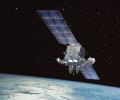
"On space, we will be able to announce that India is signing the Artemis Accords, which advance a common vision for space exploration for the benefit of all humankind," a senior administration official said hours before the meeting between Prime Minister Narendra Modi and President Joe Biden in the Oval Office.

The rocket flight was aborted in order to plug the liquid oxygen leak identified during post-static fire Falcon 9 rocket inspections.
New Delhi has targeted to boost the number of transponders India currently has from 199 to 500 by the end of the 11th five year plan (March 2012), Secretary in the Department of Space G Madhavan Nair said.

The 25-hour countdown has begun for the launch of the Indian Space Research Organisation's PSLV-C53 mission in Sriharikota.

Besides the scientists at the Indian Space Research Organisation, officials at the European Space Agency are also involved in tracking the lander module of the Chandrayaan-3 mission which is minutes away from making a soft landing on the surface of the moon, a senior scientist said on Wednesday.

Union Minister for Science and Technology Dr Jitendra Singh on Sunday announced that the Indian Space Research Organisation (ISRO) is ready to launch India's first Atmanirbhar human flight 'Gaganyaan' by the year 2024.
ISRO will build an identical GSLV and a satellite similar to INSAT-4C for a launch in June next year.
With a view to increase its surveillance capabilities, the Indian Air Force is going to have its own satellite in space by the end of 2010. "We will launch our satellite by the end of 2010," IAF chief Air Chief Marshal Fali Homi Major said in Bangalore on Thursday.

National Aeronautics and Space Administration will soon provide advanced training to Indian astronauts, with the goal of mounting a joint effort to the International Space Station, a top American diplomat said Friday.

A visibly emotional Modi addressed scientists at the Indian Space Research organisation's command centre in Bengaluru, who were involved in the Chandrayaan-3 mission and lauded them for their efforts.

The Indian Space Research Organisation (ISRO) on Monday successfully launched its maiden X-Ray Polarimeter Satellite that would offer several insights into celestial objects like black holes.

The US Air Force on Wednesday handed over NISAR, an earth observation satellite jointly developed by NASA and ISRO, to the Indian space agency.
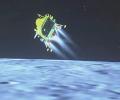
After Chandrayaan-3 touched down on the Moon, the Congress on Wednesday said it is a collective success of every Indian and ISRO's achievement reflects a saga of continuity and is truly fantastic.
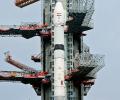
The main focus of the all weather RISAT-1B satellite will be to observe the Indian land with its C-band synthetic aperture radar.

Opposition parties are expected to announce their joint vice-presidential candidate, potentially leading to a 'south versus south' contest. Meetings and discussions have been held to finalize the candidate, with names from Tamil Nadu being considered. The opposition aims to field a non-political figure with national standing.
